Pixel Islands vs Pikmin Bloom: Which Walking Game Fits You?
Pikmin Bloom and Pixel Islands do the same basic trick: they take the steps you were going to walk anyway and turn them into progress in a game. From there they head in opposite directions. Pikmin Bloom — developed by Niantic in partnership with Nintendo — is a social, location-aware creature collector that plays while you walk. Pixel Islands is a private, low-pressure world-builder you check after the walk is done. They sit at the two ends of the whole walking-game genre.
Full disclosure before anything else: we make Pixel Islands, so read this knowing that — we'll be at least as generous to Pikmin Bloom as to ourselves. It's a genuinely lovely game, it wins several of the categories below outright, and pretending otherwise would be a strange way to earn your trust.
The quick comparison
| Dimension | Pikmin Bloom | Pixel Islands |
|---|---|---|
| Core loop | Walk with Pikmin, plant flowers along your route, collect and grow creatures | Steps grow a pixel-art island through 8 stages, then you start a new themed world |
| Uses GPS / location | Yes — it's central to the design | No — never requests location |
| Attention needed while walking | Some — it plays live as you go | None — check in after the walk |
| Social features | Friends, group walks, community events | None — fully private |
| Platforms | iOS and Android | iOS only (17+) |
| Battery impact | Higher — GPS while active | Near zero — reads Apple Health |
| Data / privacy | Location-aware by design | Step count only |
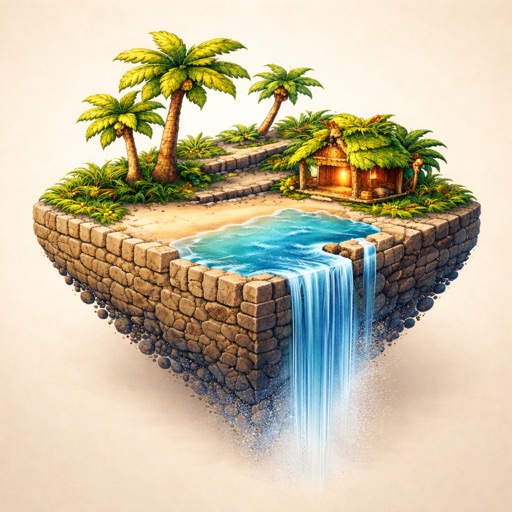
| Style | 3D, cheerful, very Nintendo | Hand-drawn pixel dioramas |
| Pressure model | Daily flowers, events, a rhythm to keep up with | No streaks, no failure — a slow week just grows slower |
Where Pikmin Bloom is better
Let's start with the other side's wins, because they're real.
Charm and polish. Pikmin Bloom has Nintendo-quality character work — the tiny creatures trotting behind you, the animations, the seasonal outfits. It's the kind of polish very few studios in the world can produce, and it makes people smile on sight.
Walking together. This is Pikmin Bloom's clearest structural win. Group walks, community days, and a big active player base turn walking into a shared activity. If your ideal walk involves other people — family strolls, meetups, comparing gardens with friends — Pixel Islands simply has nothing to offer here. It's a solo game on purpose, but that purpose won't suit everyone.
Routes that feel alive. Flowers bloom along the streets you've actually walked, so your neighborhood slowly turns into a record of your own footsteps. It's a genuinely poetic use of GPS, and the nightly recap of your day is a lovely ritual. There are AR moments too — posing your Pikmin in the real world for photos — that no Health-based game can replicate.
It runs on Android. Pikmin Bloom is free to download on both iOS and Android, with optional purchases (check the store for current details). Pixel Islands is iPhone-only. If your household mixes platforms and you want everyone in the same game, that decides it by itself.
Where Pixel Islands is better
No GPS, no location permission. Pixel Islands reads exactly one thing: your step count from Apple Health. It never asks where you are, which is better for privacy and dramatically better for battery — GPS is one of the most power-hungry things a phone does, and we've written a whole guide on why step counting barely touches your battery while location games drain it.
The walk stays yours. Nothing happens during the walk. No screen to glance at, no creatures to manage, no moment where the game wants your attention mid-stride. You walk, phone in your pocket, and check in afterwards — the whole check-in takes about ten seconds, and a home-screen widget shows your island growing without opening the app at all.
No streak guilt. There are no daily flowers to keep alive, no wilting, no broken-chain mechanics. A slow week doesn't punish you; your island just grows more slowly, and every step you do take still lands. For a lot of people this is the difference between a habit that survives a bad month and one that collapses at the first missed day.
Worlds, not one garden. Finish an island and you pick a new theme — cherry-blossom shrines, Norse halls, steampunk skyports, neon cities — so long-term progress is a shelf of tiny finished worlds rather than one ever-longer log.
The honest deciding question
Strip away the features and one question remains: do you want your walk to be the game, or to feed the game?
Pikmin Bloom makes the walk itself the play session. The creatures are with you, the flowers trail behind you, the map fills in as you move. That's magical when you want walking to feel like an event — but it also means the game is present on every walk, asking for a little bit of you each time.
Pixel Islands deliberately stays out of the walk. The walk is just a walk — headphones, a podcast, your own thoughts — and the game is the small reward waiting when you're back. Nothing about the walk changes; only what it counts for does.
Neither answer is wrong. But you almost certainly already know which one describes you, and that instinct is a better guide than any feature table.
Can you use both?
Yes — genuinely, and without conflict. The two games read your steps in different ways: Pikmin Bloom plays live while you're out, and Pixel Islands reads the finished totals from Apple Health afterwards. The same walk counts fully in both. Plenty of people will end up here: Pikmin Bloom for weekend strolls and community days, Pixel Islands as the quiet everyday layer that never asks for anything. They're less competitors than neighbors at opposite ends of the same street.
So which one?
Choose Pikmin Bloom if…
- you want walking to feel social — friends, events, a big community
- you love Nintendo's characters and want that charm on every walk
- you like seeing your real routes bloom on a map
- you're on Android, or your family is
Choose Pixel Islands if…
- you want your walk left alone — no screen, no attention, check in after
- you don't want any app knowing your location, or eating your battery
- streaks and wilting mechanics stress you out more than they motivate you
- you'd rather build a shelf of tiny finished worlds than tend one garden
Common questions
Is Pikmin Bloom or Pixel Islands better for battery life?
Pixel Islands. It reads your step count from Apple Health and never uses GPS, so its battery impact is close to zero. Pikmin Bloom is location-aware by design — completely normal for its kind of game, but it draws noticeably more power over a long walk.
Does Pixel Islands track your location like Pikmin Bloom?
No. Pixel Islands never requests location permission at all — the only thing it reads is your step count from Apple Health. Pikmin Bloom uses your location on purpose, because planting flowers along your real route is the heart of its design.
Can I play Pixel Islands and Pikmin Bloom at the same time?
Yes. They read your steps in different ways — Pikmin Bloom plays live while you walk, and Pixel Islands reads the finished total from Apple Health afterwards — so the same walk counts fully in both, with no conflict.
Is Pixel Islands available on Android?
No. Pixel Islands is iPhone-only and requires iOS 17 or later. Pikmin Bloom is available on both iOS and Android, so if your household mixes platforms, it's the one everyone can install.